
Newton County Criminal Court Records
A criminal court record is the case-level file kept by the court after charges are filed. In Newton County, felony criminal matters are handled in Superior Court, while Magistrate Court handles warrant applications, commitment hearings, misdemeanor deposit-account fraud, and related lower-court criminal steps. Probate Court and municipal courts may handle certain traffic, misdemeanor, ordinance, or city-issued matters. The Clerk of Superior Court is the main records clerk for Superior and Magistrate records.
The court file is broader than the arrest event. It can include indictments or accusations, bond orders, arraignment entries, motions, plea entries, trial activity, verdicts, sentencing orders, probation terms, and appeals. A reader checking whether a person is in custody should use jail and inmate channels. A reader checking the formal charge list, plea, disposition, or sentence should use the criminal court record.
For charge-specific context after arrest, the Newton County arrest records and court charges page separates arrest, booking, charges, and conviction status.
Search Newton County Criminal Cases
The main local search channel is the Clerk of Courts Online Case Search page and Newton County CMWebSearch. The clerk's page states that public access is available for civil and criminal records online and notes that the upgraded system provides images. CMWebSearch offers search by party, associated party, and case number. A criminal case search is most reliable when the case number is known, but a defendant name search can be used when the number is missing.
- Open the Newton County Clerk of Courts Online Case Search page.
- Use the public CMWebSearch link for civil and criminal records.
- Search by case number when available, or search by defendant name.
- Open the case and review charges, docket entries, plea, disposition, sentence, and document images when available.
- Contact the Clerk of Superior Court for certified copies, unclear images, older records, or sealed-file questions.
Statewide systems can matter for attorneys, e-filers, and registered users. Georgia Courts e-access redirects users to provider websites and says an account is required. re:SearchGA, Odyssey eFileGA, and PeachCourt support broader Georgia court-document and filing workflows, but they do not replace the Newton clerk's local public search path.
Newton County Criminal Case Flow
A Newton County criminal court record grows as the case moves. Charges may begin with a warrant or arrest, then the prosecutor files or presents the formal charge. The docket then records arraignment, pretrial motions, hearings, plea entries, trial activity, disposition, and sentencing. Each step may create a filing, order, notice, or docket entry.
Case flow: Charges Filed › Arraignment › Pretrial / Motions › Plea or Trial › Disposition › Sentencing
| Stage | What Happens |
|---|---|
| Charges Filed | The accusation, indictment, or other charging document starts the formal court case. |
| Arraignment | The defendant appears or responds to the charge and a plea may be entered. |
| Pretrial / Motions | Parties file requests for rulings, evidence issues, bond changes, or other court action. |
| Plea or Trial | The case resolves by plea, bench trial, jury trial, dismissal, or other court action. |
| Disposition | The court record shows the result for the case or each charge. |
| Sentencing | The judge enters jail, prison, probation, fine, program, or other sentence terms if there is a conviction. |
What Newton County Criminal Records Show
Criminal court records should be read charge by charge and event by event. A single case can have several counts, and each count can have a different status. One charge may be dismissed while another results in a plea. A docket may show the motion history and court dates, while a sentencing order gives the controlling sentence terms. The public index may not show every document image, and certified copies must come from the record-holding office.
| Field | What It Shows |
|---|---|
| Case Number | The court identifier used for search, docket review, and copy requests. |
| Defendant | The person charged in the criminal case. |
| Charges | The offense names or counts filed by accusation, indictment, complaint, or other charging paper. |
| Bond Order | Release terms, bond amount, or custody-related court order when entered. |
| Plea | The defendant's plea, such as guilty, not guilty, or nolo contendere where allowed. |
| Docket Entries | The timeline of hearings, motions, notices, orders, and case events. |
| Disposition | The result for the case or charge, including dismissal, guilty plea, verdict, or other outcome. |
| Sentence | The penalty or terms imposed after conviction, such as probation, confinement, or fines. |
Newton County Criminal Programs
Newton County has criminal problem-solving courts that can affect how a criminal court record resolves. Adult Felony Drug Court is designed to coordinate substance-abuse intervention with judicial supervision, sanctions, incentives, and a team model. The official page says successful completion can result in dismissed charges or a reduced sentence, and the program can serve as an option for some felony probation violators.
The Adult Felony Drug Court page documents the local treatment-court route for eligible felony criminal cases.
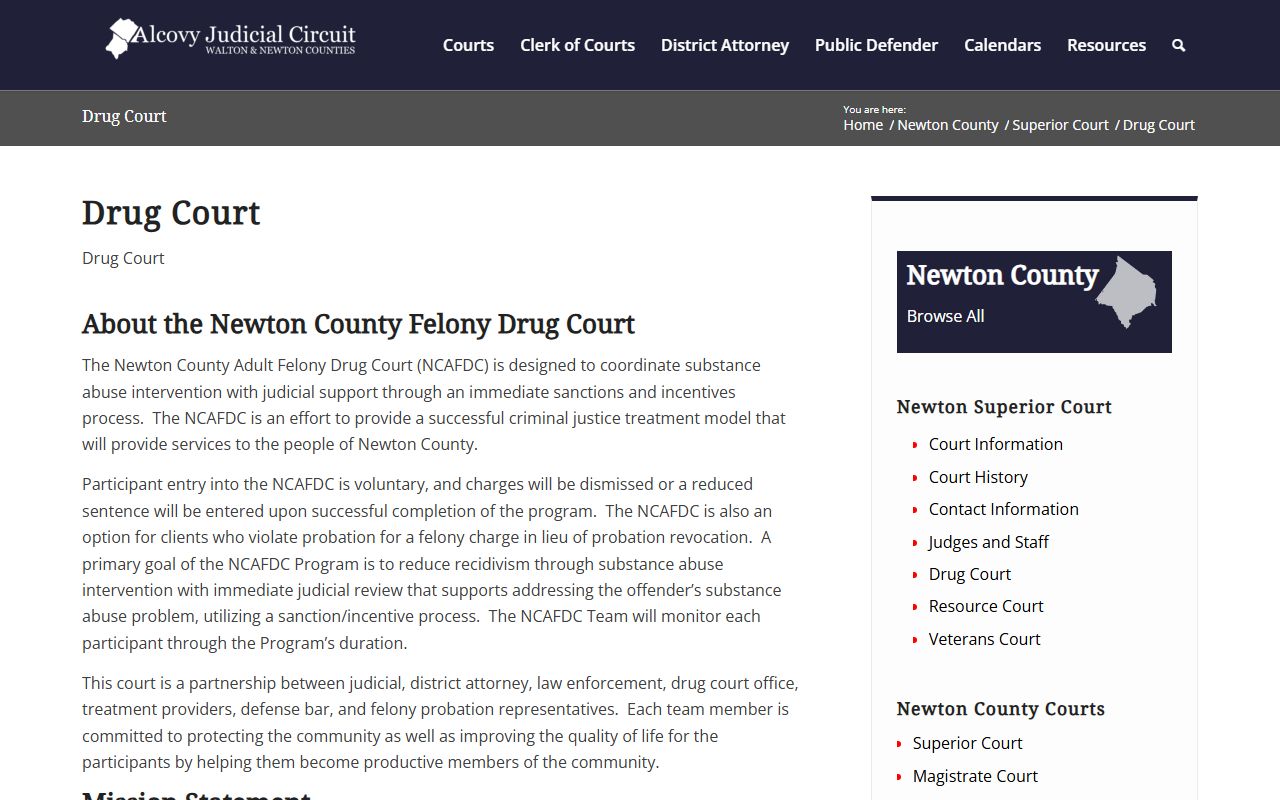
Drug Court entries may appear in a case history when a defendant is accepted into or completes that program.
Resource Court is a criminal justice program for individuals diagnosed with severe and persistent mental illness who are being prosecuted by the Newton County District Attorney's Office. Veterans Treatment Court seeks to divert eligible veteran defendants with substance dependency or mental illness who are charged with felony offenses into a specialized court model.
The Resource Court page identifies Newton County's mental-health court channel for qualifying criminal cases.
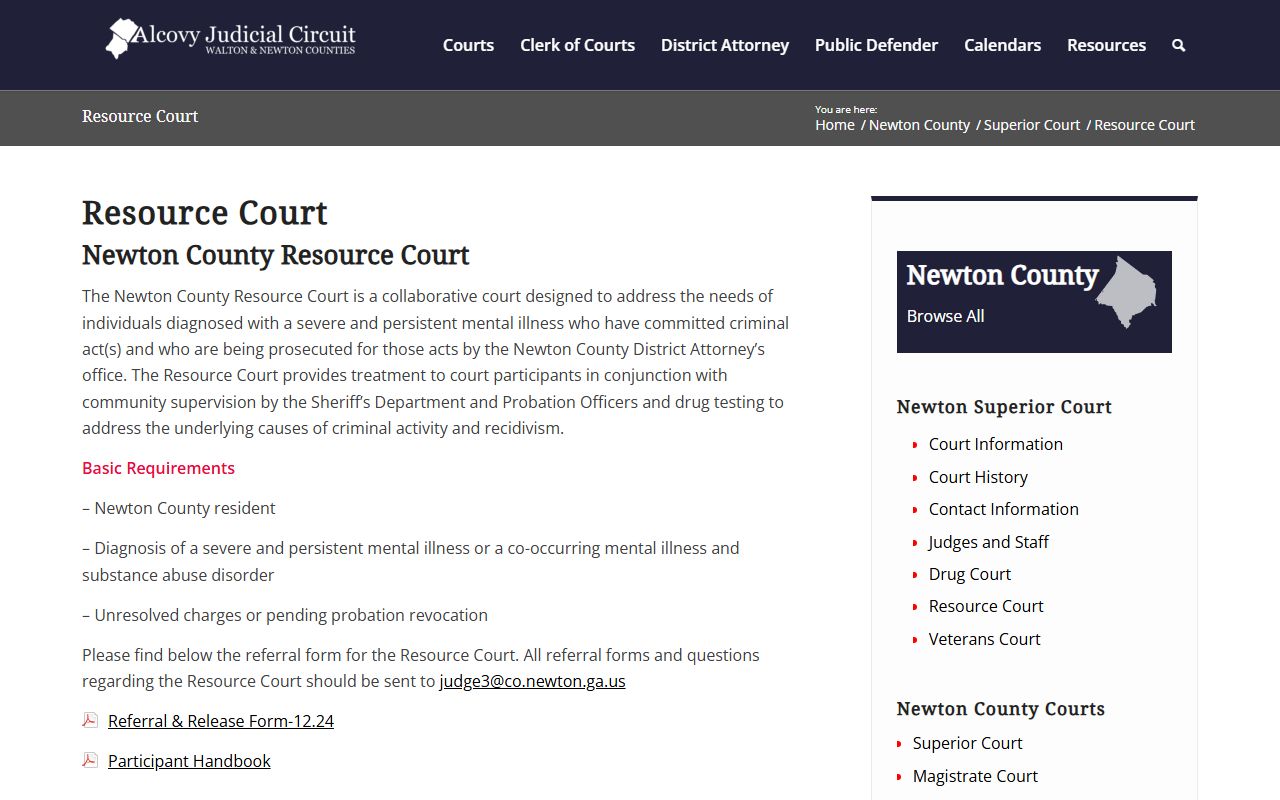
Resource Court context helps explain why some criminal court records include treatment, supervision, and review events instead of only standard hearing entries.
The Veterans Treatment Court page documents another Newton County criminal case path for eligible veterans.
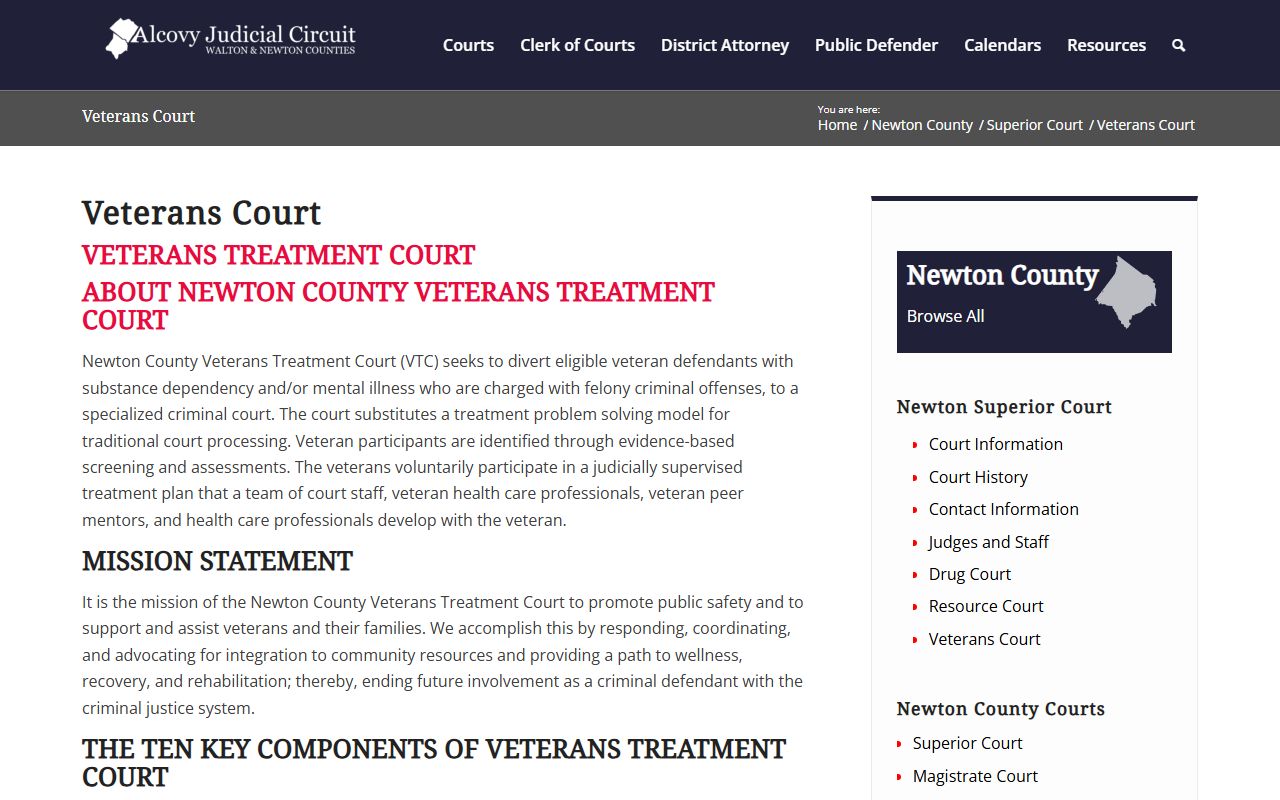
Veterans Treatment Court can change the sequence of review dates, treatment requirements, and final disposition in eligible cases.
Charges vs Convictions
A charge is an accusation filed in court. A conviction is the result of a guilty plea, guilty verdict, or other qualifying final adjudication. Newton County criminal court records may show charges that were amended, reduced, dismissed, or not proven. Do not treat a charge line as a conviction unless the docket, disposition, plea, verdict, or sentencing order supports that conclusion.
| Charge | Conviction | |
|---|---|---|
| Meaning | An allegation filed by the state | A final finding or plea resulting in guilt |
| Where Seen | Charging document and docket | Disposition, plea, verdict, and sentence |
| Can Change | May be amended, reduced, dropped, or dismissed | Usually changed only through court action, appeal, or later relief |
| Use | Shows what was accused | Shows the final criminal result |
Newton County Criminal Case Offices
The Alcovy Judicial Circuit District Attorney prosecutes felony matters for Newton and Walton Counties. The Newton County DA office is in Room 313 of the Judicial Center. The staff page names Randy McGinley as District Attorney and lists senior prosecution staff. The Public Defender office is on Pace Street in Covington and handles qualifying defendants; the public defender page states that a $50 application fee applies once the case is resolved.
The Alcovy Judicial Circuit District Attorney site is the main prosecution information channel for Newton felony matters.
District Attorney information helps identify the prosecuting office tied to felony criminal case filings in Newton County.
The District Attorney contact page gives the local office address, phone, fax, and hours.
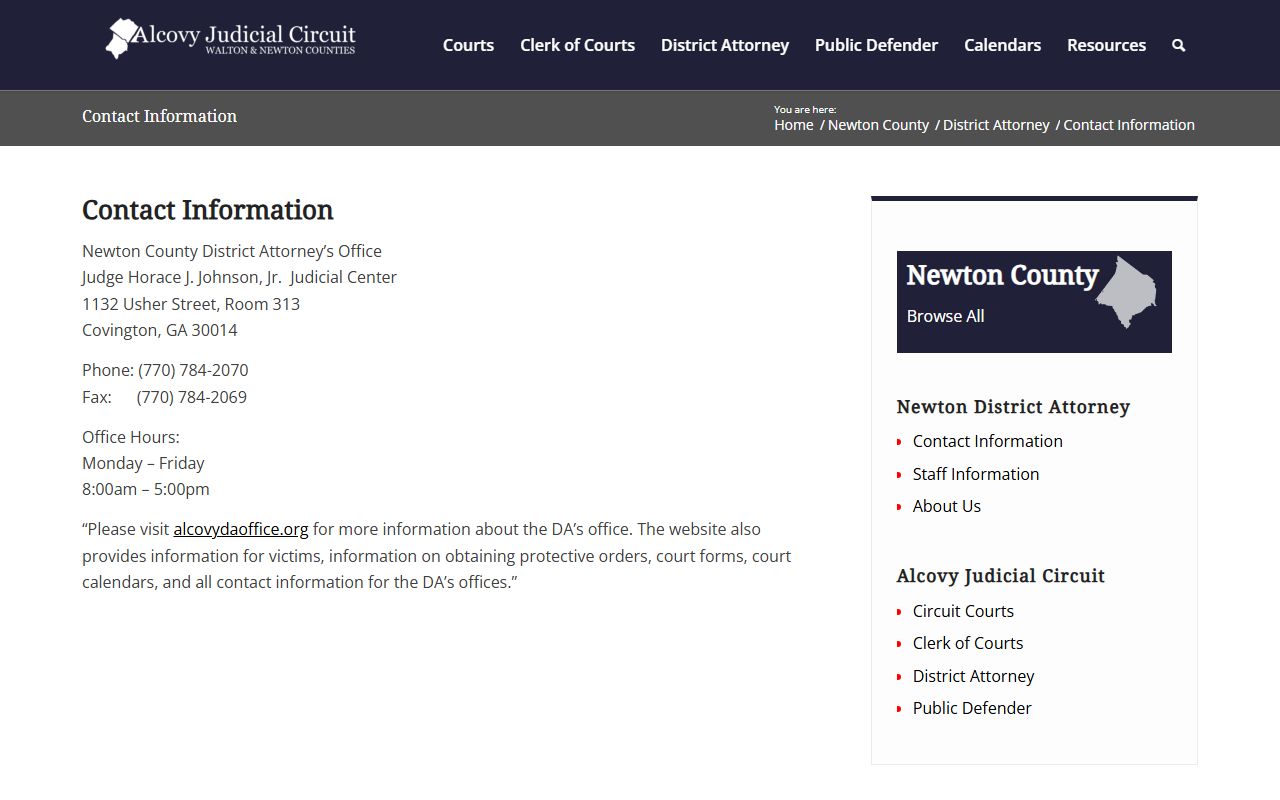
That contact route matters when a charge, plea offer, victim notice, or prosecutor record-restriction question is office-specific.
The District Attorney staff page names the elected prosecutor and key staff for Newton County criminal matters.
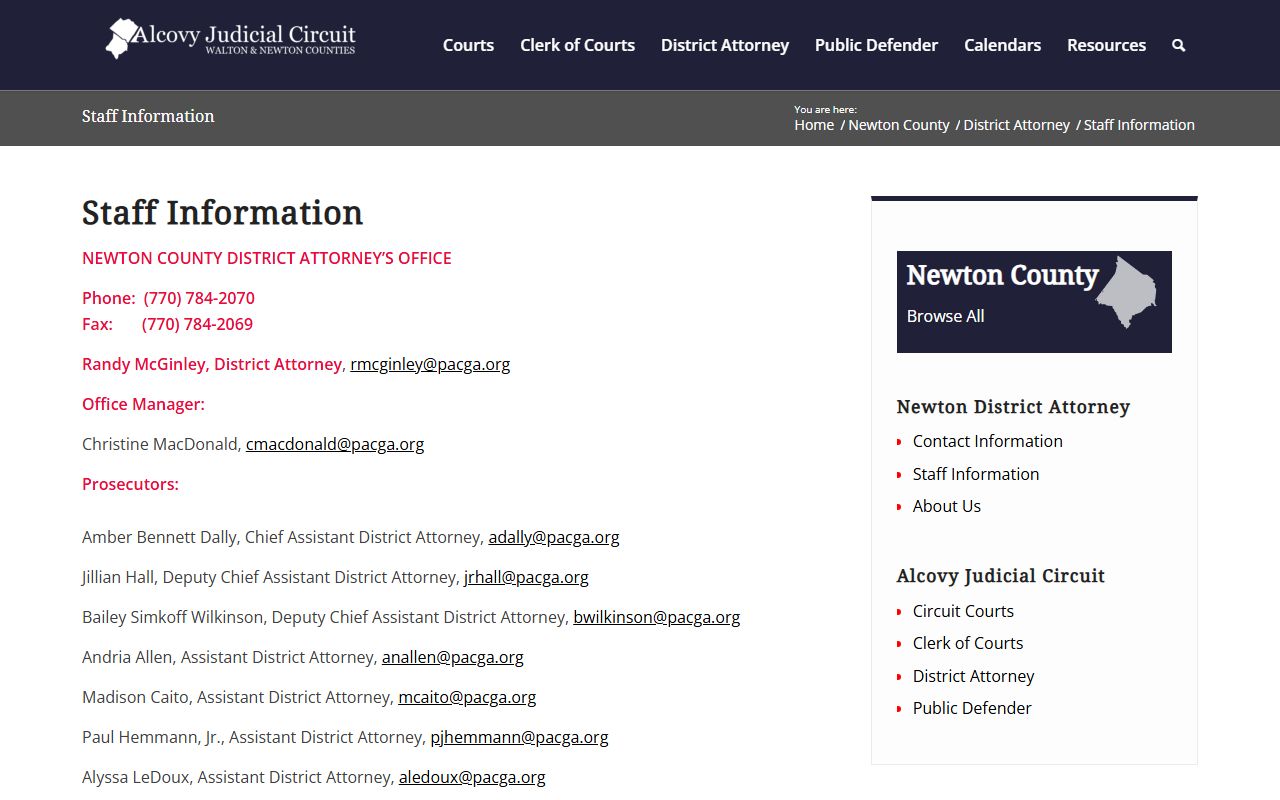
Staff information can help place a criminal court record in the correct prosecution context without replacing the clerk's official file.
Sealed vs Restricted Criminal Records
Georgia uses record restriction for eligible criminal-history information, and court-file sealing is a separate court access issue. GBI explains O.C.G.A. 35-3-37 as a process that limits public access to eligible criminal-history records for non-criminal-justice purposes. For arrests after July 1, 2013, the person contacts the prosecuting attorney. For older arrests, the person applies at the arresting agency.
| Sealed Court File | Restricted Criminal History | |
|---|---|---|
| Record Source | Court case file or part of the file | GBI/GCIC criminal-history information |
| Authority | Court rule, statute, or judge's order | O.C.G.A. 35-3-37 process |
| Public Access | Limited by court order or law | Limited for non-criminal-justice purposes if approved |
| Where to Start | Record-holding court or clerk | Prosecutor or arresting agency, depending on arrest date |
Public Access to Newton Criminal Records
Adult criminal court records are generally public unless a statute, court order, juvenile rule, sealing rule, or redaction requirement applies. Uniform Superior Court Rule 21 recognizes public inspection of court records unless access is limited by law or the rule's sealing process. Georgia's Open Records Act also presumes public records are available unless a specific exemption applies, but the county's guidance sends court case records to the Clerk of Courts rather than the generic county open-records form.
Restricted records include juvenile cases, sealed cases, protected personal identifiers, and some criminal-history information eligible for GBI record restriction. A Newton Superior Court docket may remain visible even when a criminal-history report is restricted, unless a court also limits the court file. That is why criminal court record research should distinguish the clerk's case file from a statewide criminal-history check.
Note: A public docket entry is not the same as a certified criminal judgment or statewide background-check result.