
Newton County Arrest Records and Court Charges
Arrest records begin with the law enforcement event. They can involve the arresting agency, booking process, custody status, bond category, and jail record. In Newton County, the Sheriff's Office and Jail are at 15151 Alcovy Road, and the sheriff website links to inmate search, warrants, sex-offender information, records requests, and jail pages. Sheriff Ezell Brown is named on the official Office of Sheriff page.
Court charges begin when the prosecutor or charging authority files formal allegations with the court. For felony matters in Newton County, the Alcovy Judicial Circuit District Attorney prosecutes cases for Newton and Walton Counties. Magistrate Court handles warrant and commitment steps, while Superior Court handles felony trials and criminal case files. The full case file and final outcome belong with Newton County criminal court records, while the arrest-to-charge pathway focuses on booking, charges filed, charge changes, bond, and restrictions.
The Newton County Sheriff's Office home page is the local law enforcement starting point for arrest records, jail links, warrants, and records request channels.

The sheriff source is useful for custody-side arrest information, while the clerk and courts control formal court charge records.
Find Newton County Arrest Records and Charges
Start with the record type. Current custody and booking information routes through the sheriff-linked inmate search and jail channels. Formal charges after arrest route through the Clerk of Superior Court case search when the case is filed in Superior or Magistrate records. A warrant or first appearance can point to Magistrate Court. A felony prosecution points to the District Attorney and Superior Court. City ordinance or municipal traffic charges may belong to the issuing municipal court.
Newton County also has a public-records split. The Sheriff's Office records request channel is the better fit for sheriff incident, arrest, and jail records that are not court filings. The Clerk of Superior Court is the better fit for the filed criminal case, charge document, docket, plea, disposition, or sentencing order. Probate, Juvenile, and municipal courts keep their own records when the charge began in those courts.
- Check the sheriff-linked inmate search for current custody or recent booking context.
- Use Newton County CMWebSearch to look for the court case by defendant name or case number.
- Read the charge list and docket entries to see whether charges are pending, amended, reduced, dismissed, or disposed.
- Contact the Clerk of Superior Court for certified charge filings, sentencing orders, or unclear document images.
- Use the District Attorney or arresting agency route for Georgia record-restriction questions, depending on arrest date.
The Newton County inmate records page is the better route for roster and jail-status details that are not court charge records.
Court Charges After Arrest
Court charges after arrest are made formal through a charging document or court filing. Georgia criminal practice can involve complaints, accusations, and indictments depending on the court, charge level, and prosecution path. The research identifies felony prosecution through the Alcovy Judicial Circuit District Attorney, warrant and commitment steps through Magistrate Court, and criminal Superior Court case files through the Clerk of Superior Court.
| Charging Document | Who Uses It | What It Does |
|---|---|---|
| Complaint | Officer, complainant, or prosecutor depending on the matter | Starts or supports a lower-court criminal allegation or warrant-related process. |
| Accusation | Prosecutor | Files formal criminal charges without describing it as a grand-jury indictment. |
| Indictment | Grand jury through the prosecution process | Formally charges felony counts that proceed in Superior Court. |
The filing document matters because it starts the court charge record. An arrest alone does not prove that each suspected offense became a filed court charge, and a filed charge does not prove a conviction.
Charge severity also controls where the case is likely to move. Felony charges belong in Superior Court. Some warrant and commitment steps pass through Magistrate Court. Certain traffic and misdemeanor matters can be handled by Probate Court or municipal courts depending on the issuing agency and offense type. The court named on the paperwork is often the best clue.
Newton County Charge Status Terms
A court charge can change while the case moves. A count may start as one offense, then be amended, reduced, dismissed, or resolved through plea or trial. A docket should be read by count, not just by case number. One Newton County case can have more than one charge, and each charge can have a different status or disposition.
| Status | What It Means |
|---|---|
| Pending | The charge remains open and no final disposition has been entered. |
| Amended | The filed charge was changed by prosecutor action or court order. |
| Reduced | The charge moved to a lesser offense or lower severity level. |
| Dismissed | The charge was ended without a conviction on that count. |
| Nolle Prosequi | The prosecution declined to proceed on the charge, often shown as a dismissal-type entry. |
| Disposed | The court entered a final result for the charge or case. |
Newton County Arrest Record Sources
The sheriff side of an arrest record includes channels that are not the same as the court charge file. The sheriff website links to jail FAQ, visitation, commissary, bond process, public records, submit records request, inmate search, warrants, and sex offenders. The Sheriff's public-records pages should be used for law-enforcement records that are not court filings. Active investigations, sealed warrants, juvenile material, and safety-sensitive records may be withheld or redacted.
The Office of Sheriff page identifies Sheriff Ezell Brown and the command structure behind Newton County arrest and jail records.
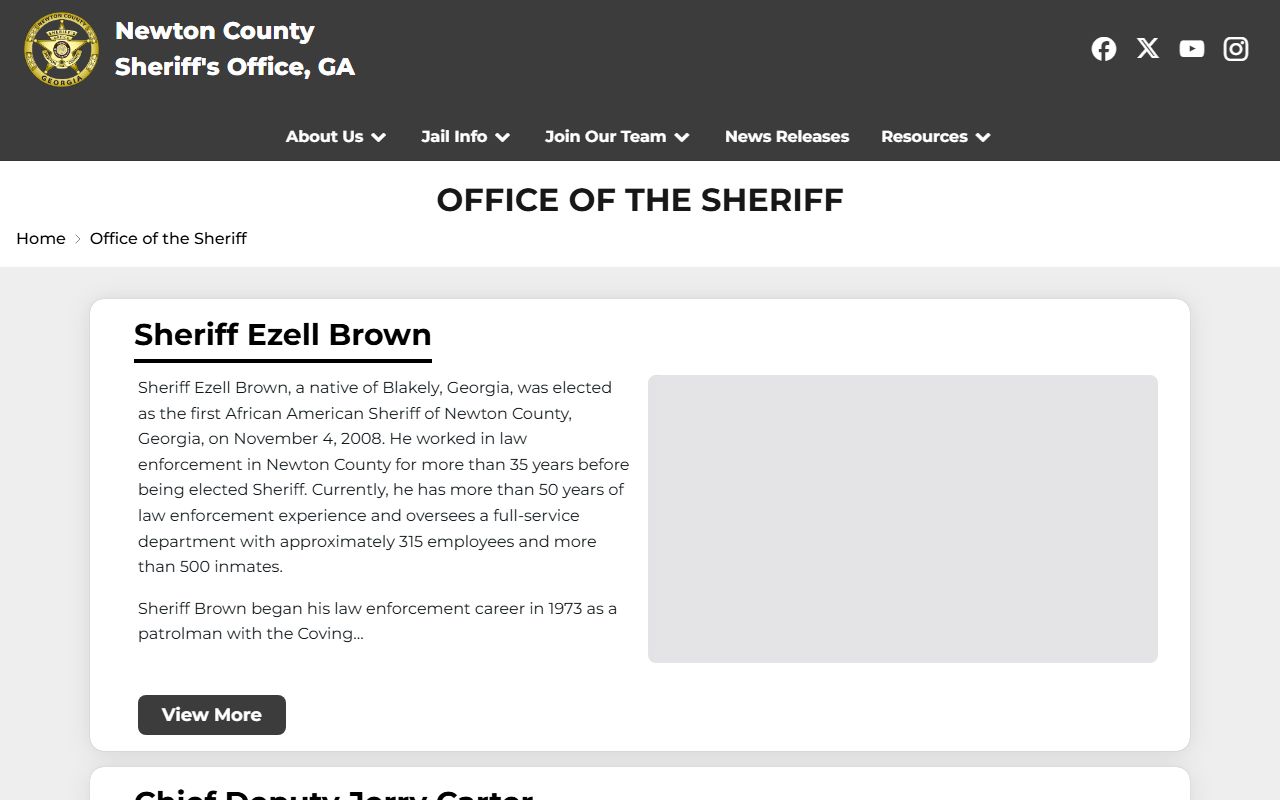
That office context helps separate law-enforcement record requests from clerk-held court charges.
The Newton County Jail FAQ is the sheriff channel for common custody, criminal-history, property, mail, money, court-date, visitation, and phone-service topics.
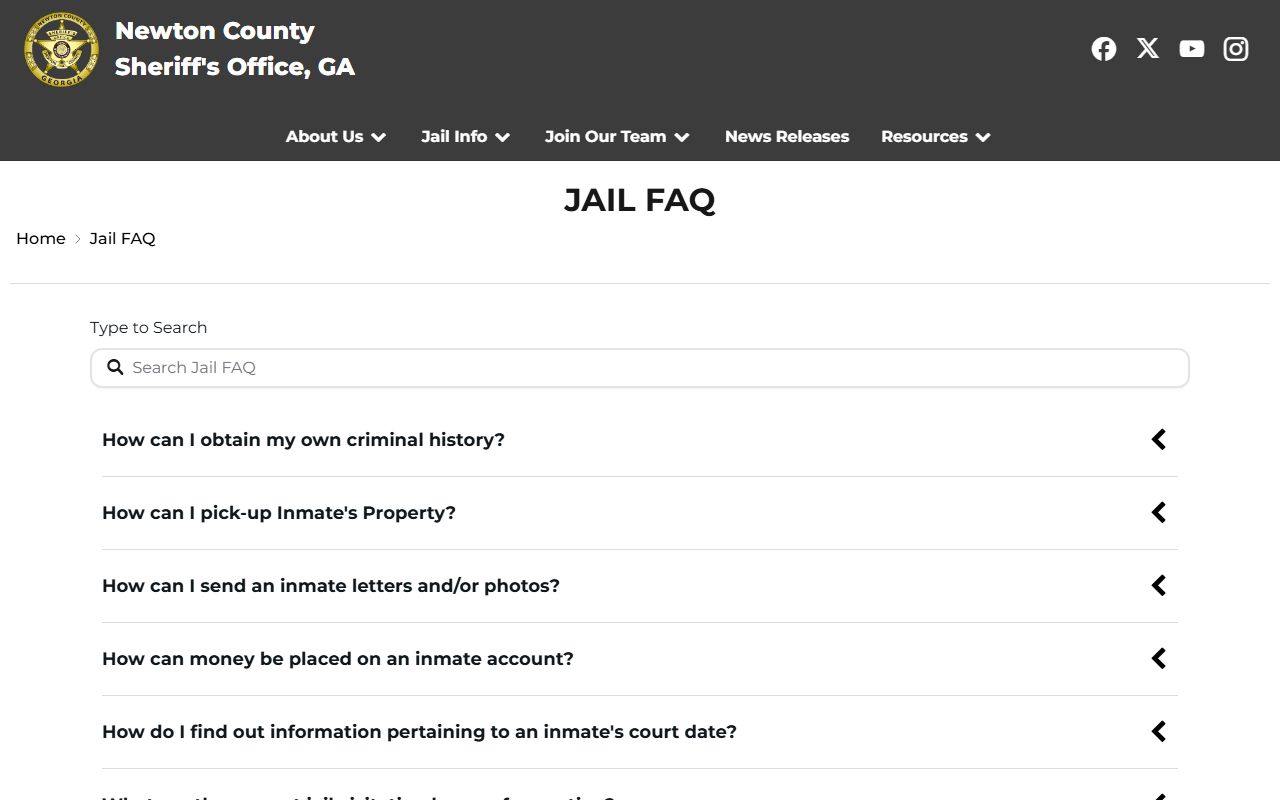
Jail FAQ topics may answer booking-side questions that will not appear in a formal court charge record.
Bond and Release After Arrest
Bond information can sit between arrest records and court charges. The Sheriff's Bond Process page lists cash bonds, property bonds, bondsman or surety bonds, transfer bonds, and city bond topics for Covington, Porterdale, and Oxford. Bond paperwork may show custody and release conditions, while the court docket may later show bond orders, revocations, or changes. Bond is not a conviction. It is tied to release and court appearance.
The Sheriff's Bond Process page documents the bond categories connected to Newton County arrest records.
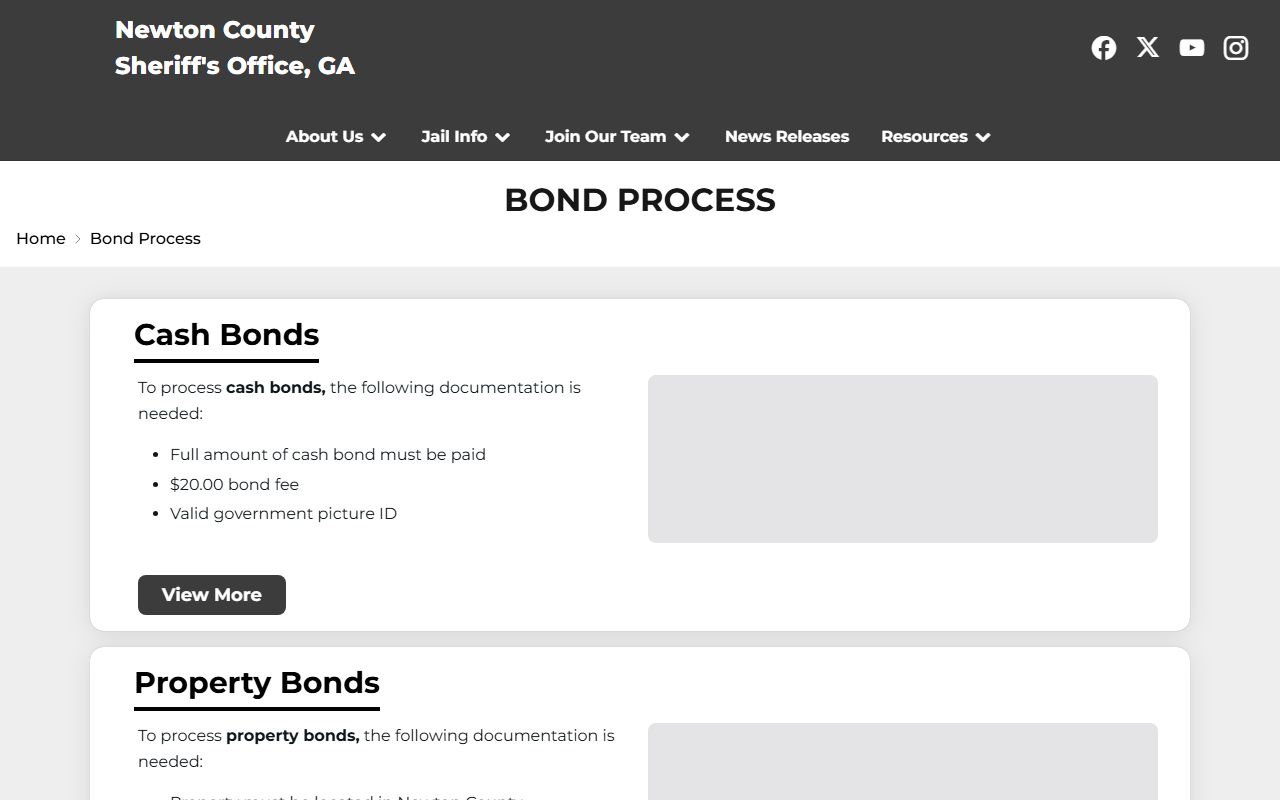
Bond categories help explain why an arrest record can show release information before the criminal court record reaches final disposition.
Prosecutor and Defense Channels
The Alcovy Judicial Circuit District Attorney decides and prosecutes felony charges for Newton County. The DA office is in Room 313 at the Judicial Center, with phone 770-784-2070. The staff page names Randy McGinley as District Attorney. The Public Defender office is at 1160 Pace Street in Covington, phone 770-788-3750, and the research notes a $50 application fee for anyone who completes an application for services, paid once the case is resolved.
The Newton County Public Defender page explains appointed-counsel access for qualifying defendants.
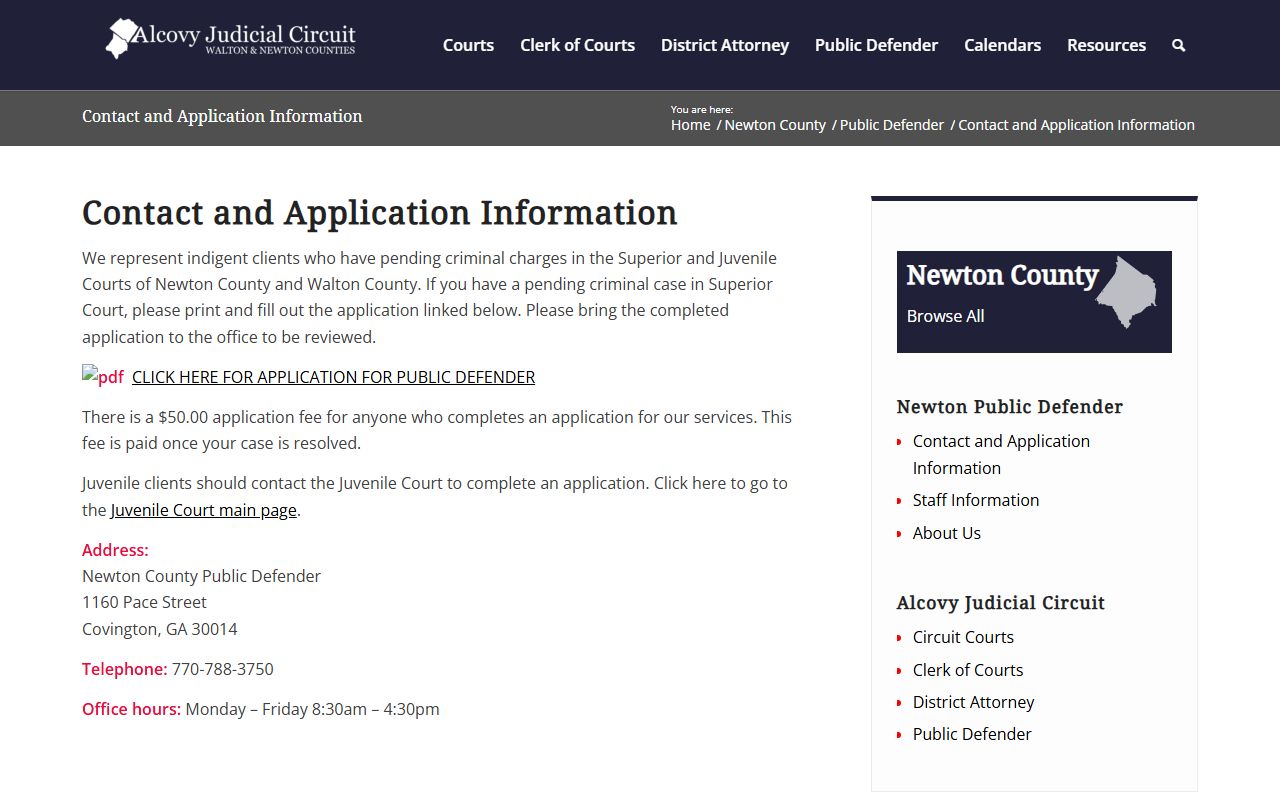
Public Defender information matters when an arrest has moved into formal charges and the defendant needs appointed counsel.
Charges vs Convictions
A charge is the allegation filed after arrest. A conviction is a final criminal result based on a guilty plea, verdict, or other qualifying adjudication. Newton County arrest records can show a person was booked. Court charge records can show what the prosecutor filed. Neither one should be read as a conviction unless the criminal court record shows the plea, verdict, disposition, and sentence that support it.
| Charge | Conviction | |
|---|---|---|
| Meaning | Formal accusation after arrest | Final guilty result or qualifying adjudication |
| Where Found | Charging document, docket, complaint, accusation, or indictment | Disposition, plea, verdict, judgment, and sentence |
| Can Change | May be amended, reduced, dismissed, or dropped | Changes only through later court action or relief |
| Risk of Misread | Can look serious even if later dismissed | Should be verified against the final court record |
Georgia Charge and History Restrictions
Statewide criminal-history treatment is different from the Newton court charge file. GBI explains O.C.G.A. 35-3-37 as Georgia's record-restriction process for eligible criminal-history records. For arrests after July 1, 2013, the person contacts the prosecutor. For arrests before July 1, 2013, the application starts with the arresting agency. That process can restrict public criminal-history access for non-criminal-justice purposes, but it does not automatically rewrite every court docket entry unless the court file is also sealed or restricted.
The GBI criminal-history record restriction page is the state source for eligible Georgia criminal-history restrictions.
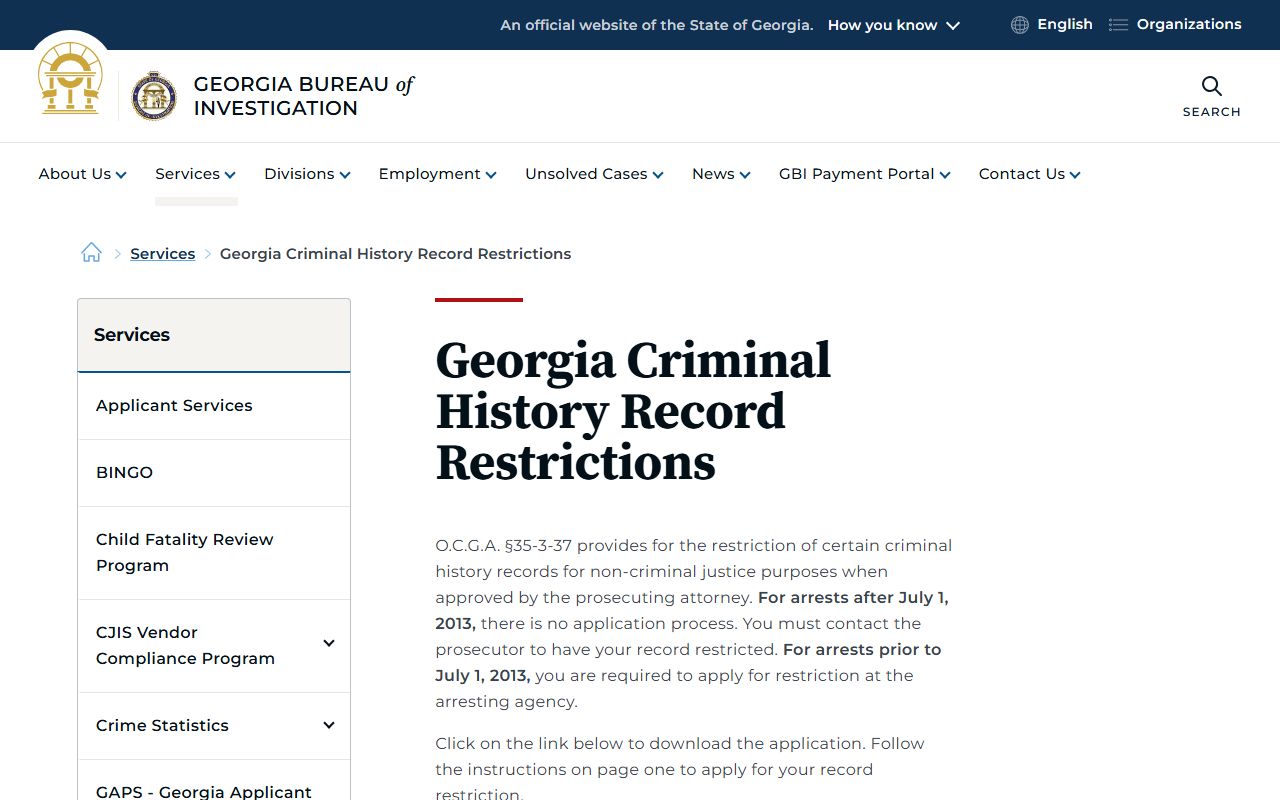
GBI restriction rules should be read separately from Newton County clerk access to the court charge record.
Sealed and Restricted Charge Records
Some Newton County arrest records and charge records are not open to the public. Juvenile cases are more restricted than adult cases. Sealed court files may be hidden by court order or rule. Criminal-history restriction may limit public access to eligible GBI/GCIC history for non-criminal-justice purposes. Active investigations, sealed warrants, protected personal identifiers, and safety-sensitive law-enforcement records may also be withheld or redacted.
| Sealed Court Record | Restricted Criminal History | |
|---|---|---|
| Record Type | Court file, docket, or document access | State criminal-history information |
| Decision Source | Judge, law, or court rule | GBI process, prosecutor, or arresting agency route |
| Public Effect | Public court access is limited | Public non-criminal-justice access is limited |
| Newton Starting Point | Record-holding court or Clerk of Superior Court | District Attorney or arresting agency, based on arrest date |
Note: A dismissed charge may still need a separate restriction or sealing process before public access changes.